
What does resistance mean today? What can past struggles for resistance teach us about the society we are part of? And how do historical events and conflicts shape our understanding of contemporary reality in Europe, in a world view that is constantly changing?
These are some of the questions explored by the exhibition Resistance. The exhibition presents works by Mindaugas Lukošaitis (b. 1980) and Deimantas Narkevičius (b. 1964), two of Lithuania’s most prominent contemporary artists.
Together, Mindaugas Lukošaitis and Deimantas Narkevičius represent two different, yet deeply interconnected approaches to storytelling. Their works offer insights into Lithuania’s past and present, while opening up universal reflections on memory, power, community, and humanity’s place in history. Although their media differ – Lukošaitis with his intense black-and-white drawings and Narkevičius with his cinematic and documentary works – they share a common interest in how history and political structures shape human life and collective memory.
Mindaugas Lukošaitis
Lukošaitis’ works are characterized by powerful, hand-drawn narratives that move between the mythical and the deeply human. Through detailed, serial drawings, he depicts conflict, power structures, and vulnerability, placing the individual at the center of larger historical and existential dramas.
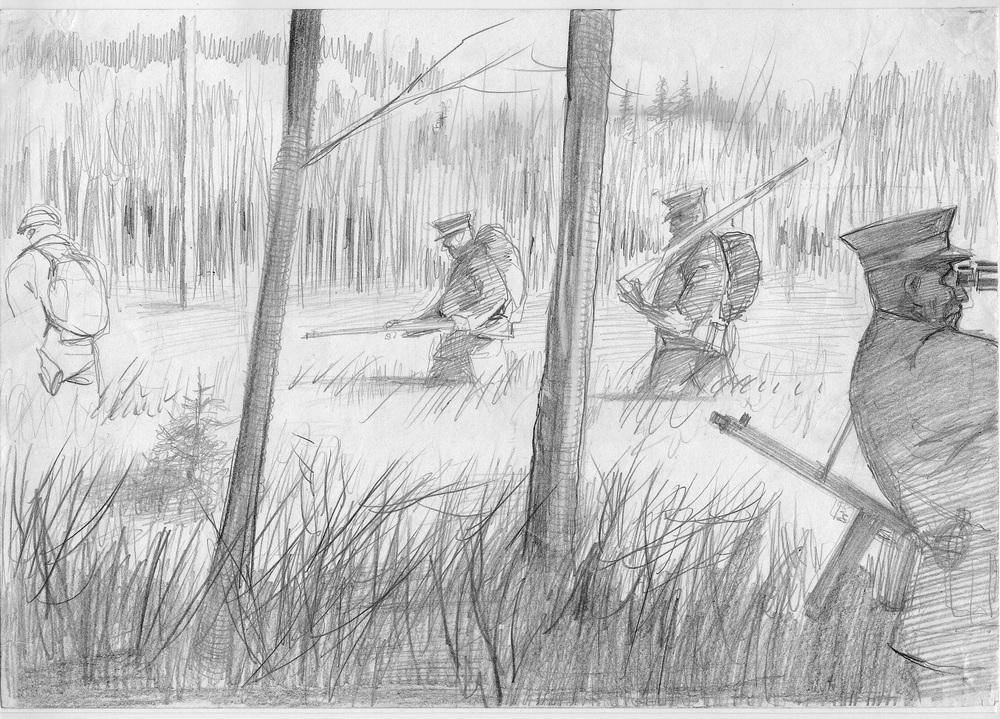
This is evident in the work Resistance (2004), from which the exhibition takes its title. The work consists of 126 pencil drawings on white paper depicting a group of Lithuanian resistance fighters in the period following the Second World War, all alert and ready for combat. Lukošaitis created the work at a time when Lithuania was on the verge of joining the EU and NATO, situating it thematically within a not-so-distant past and present. The work thus points to a thought-provoking and unsettling relevance in the context of the current situation in Europe and an ever-changing landscape of threats and worldviews.
Deimantas Narkevičius
Narkevičius’ practice draws on documentary film traditions, and he works with archival material, interviews, and poetic montage. His works examine political ideologies, social change, and the traces that the Soviet era and post-Soviet experiences have left on contemporary culture and identity. This is evident in the two video works The Role of a Lifetime (2003) and The Head (2007), which are also featured in the exhibition.

The works are kindly on loan from the Louisiana Museum of Modern Art, Humlebæk.
Supported by